FULFILLED PREDICTIONS
FULFILLED PREDICTIONS
The following is a record of times when any of my predictions are either completely or partially fulfilled. Each record will be accompanied by the corresponding prediction number for clarity.
Prediction 327. President Donald Trump will not win the 2020 election.
8/12/2020. He didn’t.
Prediction 11. Antichrists tend to initially ally with the Russians, then fight against them.
15/12/2021. MOSCOW, Dec 15 (Reuters) - Russia and China should stand firm in rejecting Western interference and defending each other's security interests, presidents Vladimir Putin and Xi Jinping agreed in a video call on Wednesday.
(https://www.reuters.com/world/china/russia-says-xi-backs-putin-push-western-security-guarantees-2021-12-15/)
15/12/2021. 'MOSCOW, Dec 15, 2021 (Reuters) - Russia and China should stand firm in rejecting Western interference and defending each other's security interests, presidents Vladimir Putin and Xi Jinping agreed in a video call on Wednesday.' (https://www.reuters.com/world/china/russia-says-xi-backs-putin-push-western-security-guarantees-2021-12-15/).
3 minute readDecember 16, 20214:41 AM GMT+11Last Updated 9 months ago
Putin and Xi cement partnership in face of Western pressure
- Xi accuses West of meddling in Chinese affairs
- Kremlin says Xi backs Putin push for security guarantees
- Putin, Xi expected to meet at Beijing Winter Olympics in Feb
- Trade between Russia and China rising sharply - Putin
MOSCOW, Dec 15 (Reuters) - Russia and China should stand firm in rejecting Western interference and defending each other's security interests, presidents Vladimir Putin and Xi Jinping agreed in a video call on Wednesday.
Their conversation, eight days after Putin spoke to U.S. President Joe Biden in a similar format, underscored how shared hostility to the West is bringing Moscow and Beijing closer together.
"At present, certain international forces under the guise of 'democracy' and 'human rights' are interfering in the internal affairs of China and Russia, and brutally trampling on international law and recognized norms of international relations," China's state-run Xinhua news agency quoted Xi as saying.
"China and Russia should increase their joint efforts to more effectively safeguard the security interests of both parties."
Kremlin aide Yuri Ushakov told reporters that Xi had offered support to Putin for his push to obtain binding security guarantees for Russia from the West, saying he understood Moscow's concerns.
He said the pair also expressed their "negative view" of the creation of new military alliances such as the AUKUS partnership between Australia, Britain and the United States and the Indo-Pacific "Quad" of Australia, India, Japan and the United States.
The call highlighted the ways in which Russia and China are drawing on each other for mutual support at a time of high tension in their relations with the West. China is under pressure over human rights and Russia is accused of threatening behaviour towards Ukraine.
Latest Updates
- Why no news may be good news for China-watching investors
- Toyota to start selling small electric sedan in China by year-end - sources
- Asia markets slugged by recession risk, dollar strength
- Dollar scales new 2-decade high, sterling on the ropes again
The Kremlin said Putin briefed Xi on his conversation with Biden, in which the U.S. president warned Russia against invading Ukraine - which Moscow denies it is planning - and Putin set out his demand for security pledges.
"A new model of cooperation has been formed between our countries, based, among other things, on such principles as non-interference in internal affairs and respect for each other's interests," Putin told Xi.
Prediction 184. This is how I think the immediate future of the Chinese leadership will look. Xi’s excessively transparent disrespect towards the rest of the world, especially regarding the COVID-19 breakout and China’s immediate response to it, will hurt China’s international interests and weaken their alliances.
Prediction 184. This is how I think the immediate future of the Chinese leadership will look. Xi’s excessively transparent disrespect towards the rest of the world, especially regarding the COVID-19 breakout and China’s immediate response to it, will hurt China’s international interests and weaken their alliances.
https://www.pewresearch.org/global/2020/10/06/unfavorable-views-of-china-reach-historic-highs-in-many-countries/
Unfavorable Views of China Reach Historic Highs in Many Countries
Majorities say China has handled COVID-19 outbreak poorly
By Laura Silver, Kat Devlin and Christine Huang
How we did this
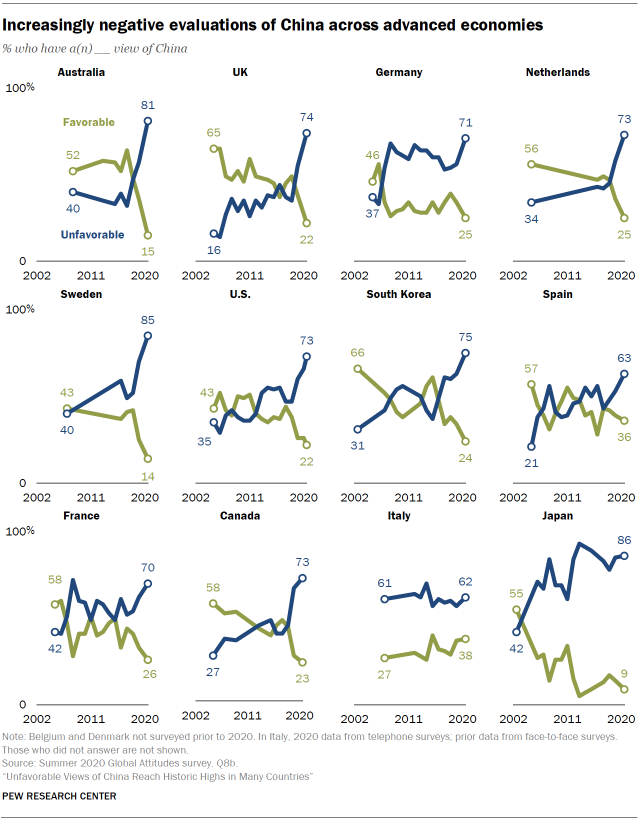
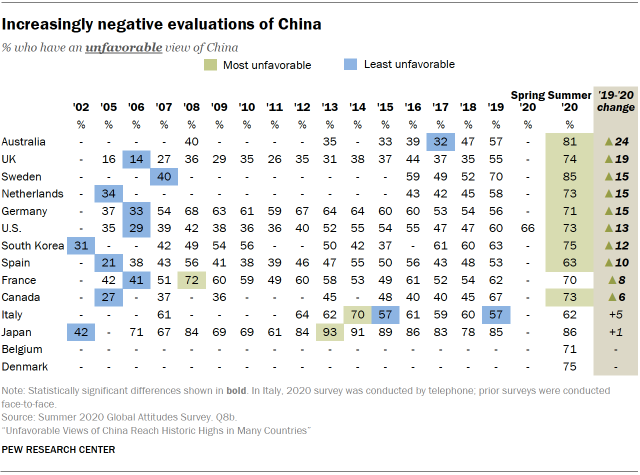
Views of China have grown more negative in recent years across many advanced economies, and unfavorable opinion has soared over the past year, a new 14-country Pew Research Center survey shows. Today, a majority in each of the surveyed countries has an unfavorable opinion of China. And in Australia, the United Kingdom, Germany, the Netherlands, Sweden, the United States, South Korea, Spain and Canada, negative views have reached their highest points since the Center began polling on this topic more than a decade ago.
Negative views of China increased most in Australia, where 81% now say they see the country unfavorably, up 24 percentage points since last year. In the UK, around three-quarters now see the country in a negative light – up 19 points. And, in the U.S., negative views of China have increased nearly 20 percentage points since President Donald Trump took office, rising 13 points since just last year.
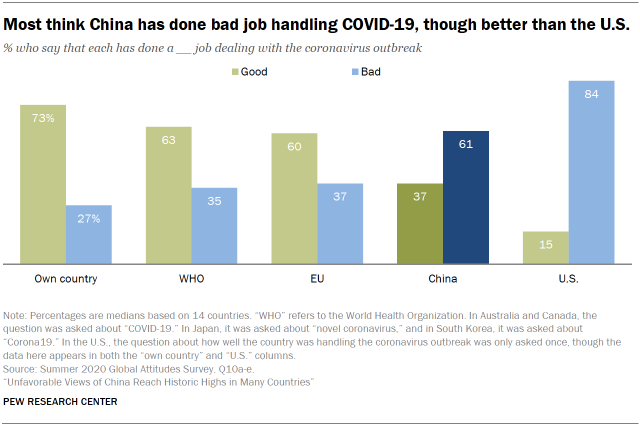
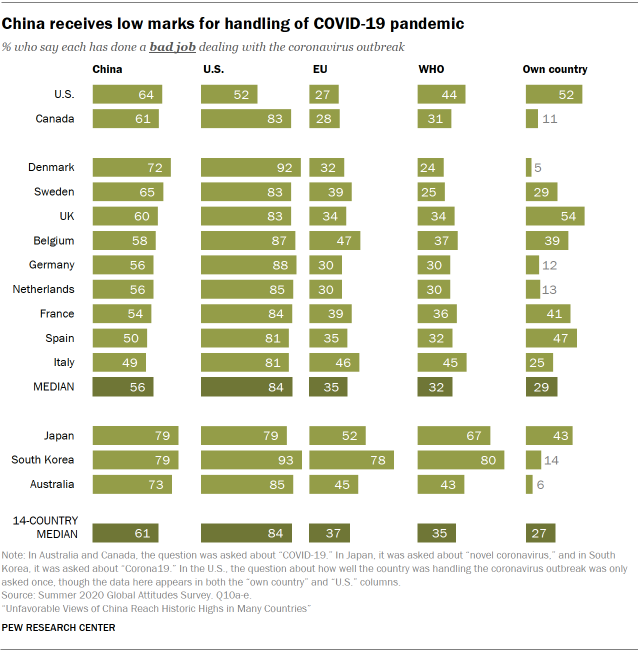
The rise in unfavorable views comes amid widespread criticism over how China has handled the coronavirus pandemic. Across the 14 nations surveyed, a median of 61% say China has done a bad job dealing with the outbreak. This is many more than say the same of the way the COVID-19 pandemic was handled by their own country or by international organizations like the World Health Organization or the European Union. Only the U.S. receives more negative evaluations from the surveyed publics, with a median of 84% saying the U.S. has handled the coronavirus outbreak poorly.
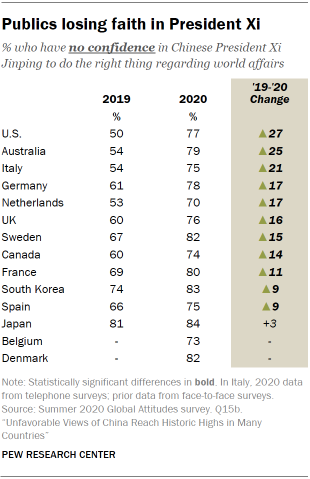
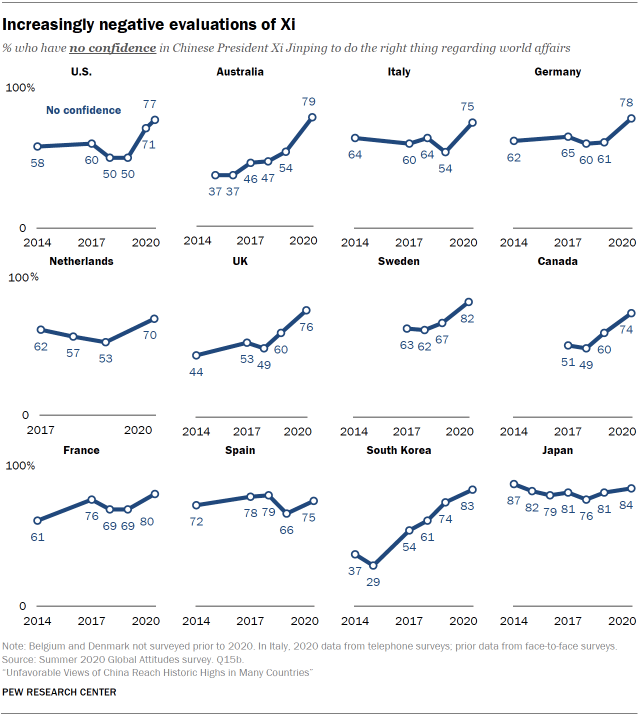
Disapproval of how China has handled the COVID-19 pandemic also colors people’s confidence in Chinese President Xi Jinping. A median of 78% say they have not too much or no confidence in him to do the right thing regarding world affairs, including at least seven-in-ten in every country surveyed. This lack of confidence in Xi is at historic highs in every country for which trend data is available except Japan and Spain. In most countries, the percent saying they have not too much or no confidence in him has grown by double digits since last year. For example, in the Netherlands, whereas around half distrusted Xi last year, today 70% say the same – up 17 percentage points.
But, even as concerns about Xi rise, in most countries, more have faith in President Xi than in President Trump. For example, in Germany, 78% say they have no confidence in Xi – but 89% say the same of Trump. Still, while Xi’s global image is somewhat better than Trump’s, it nonetheless is significantly worse than several of the other world leaders asked about, including German Chancellor Angela Merkel, French President Emmanuel Macron and UK Prime Minister Boris Johnson.
When it comes to perceptions of economic strength, China fares relatively well in the survey. Of four options given, people in most countries polled are most likely to see China as the world’s top economy. This is particularly true in Europe, where a plurality or majority in every country surveyed says China is the world’s leading economic power. Outside of the U.S. itself – where 52% of Americans say the U.S. is the world’s leading economic power – only in Japan (53%) and South Korea (77%) do more name the U.S. than China.
But even while pluralities or majorities in most countries note China’s economic strength relative to the U.S., this opinion does little to color attitude toward China more broadly. In almost every country surveyed, people who name China as the top economic power and people who name the U.S. are equally likely to have unfavorable views of China. People’s own pocketbooks also have little bearing on their views of China. In most countries surveyed, those with higher income levels are equally likely as those with lower levels of income to give the country low marks.1
These are among the findings of a new Pew Research Center survey, conducted June 10 to Aug. 3, 2020, among 14,276 adults in 14 countries.
Negative views of China on the rise
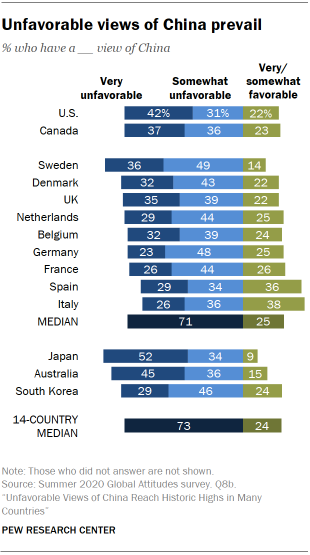
A majority in each of the 14 countries surveyed has an unfavorable view of China. In most countries, around three-quarters or more see the country in a negative light. In Spain, Germany, Canada, the Netherlands, the U.S., the UK, South Korea, Sweden and Australia, negative views have reached their highest level in the 12 or more years that Pew Research Center has been polling in these countries.
Around a third or more in Belgium, Denmark, the UK, Sweden, Canada, the U.S., Australia and Japan also have very unfavorable views of China. In both the UK and Australia, this is more than twice as many as said they had very unfavorable views of China last year.
In most countries, views soured significantly since just last year. For example, in Australia – where efforts to investigate China’s role in the spread of COVID-19 have led to heated trade frictions – negative views of China have gone up 24 percentage points since 2019. This is also the largest year-on-year change in Australia since the question was first asked in 2008.
Negative views increased by double digits over the past year in the UK, Germany, the Netherlands, Sweden, the U.S., South Korea and Spain.
While these changes since last year are stark, in some countries, they are part of a larger trajectory. In the U.S., for example, unfavorable opinion of China has ticked up steadily since 2018. Similarly, in South Korea, the UK, the Netherlands, Canada and Sweden, this marks the second year in a row where negative views have reached historic highs.
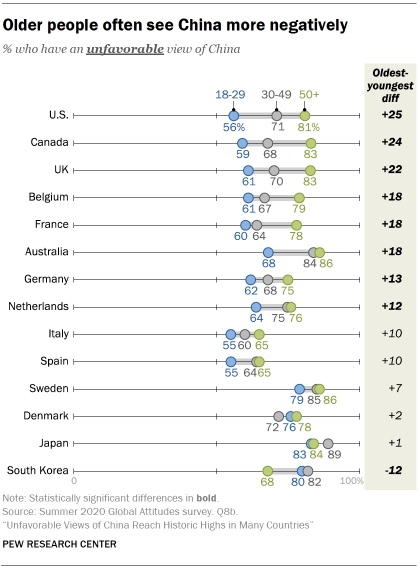
As has traditionally been the case in Pew Research Center polling, older people tend to have more unfavorable views of China than younger people. For example, in Australia, 68% of those under 30 have an unfavorable view of China, compared with 86% of those ages 50 and older. This also marks the first year in which a majority of younger Australians have an unfavorable view of China; in 2019, 45% of those under 30 reported the same.
In the U.S., too, 2020 is the first year in which more than half of young Americans expressed negative views toward China. The only country surveyed in which younger people hold more unfavorable views of China than their elders is South Korea.
In contrast, education plays little role in people’s assessments of China. Across each of the 14 countries surveyed, those with a postsecondary degree or more are equally likely to have unfavorable views of China as those with less education. Men and women are also equally likely to have unfavorable views of China in nearly all countries surveyed.
In the U.S., Republicans and independents who lean toward the Republican Party hold more unfavorable views of China than Democrats and independents who lean toward the Democratic Party. Aside from the U.S. – where conservatives tend to have more unfavorable views of China than liberals – ideology has little or no relationship with views of China in the other countries surveyed.
Most think China has not handled COVID-19 outbreak well
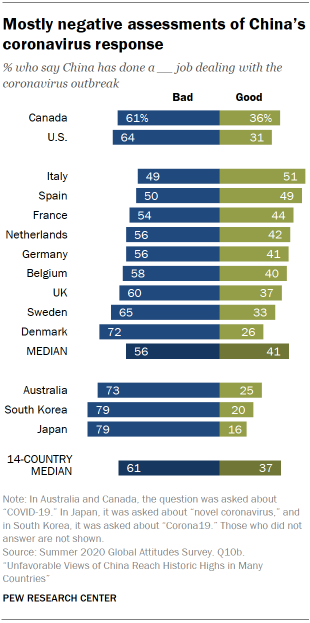
After initial cases of the coronavirus started appearing in China’s Hubei Province in late 2019, many around the world questioned the expediency of China’s response to the outbreak, and others critiqued some of the measures Beijing used to contain the virus within its borders. But in Wuhan, the original epicenter of the outbreak, the strict lockdown has ended and the new case count plummeted to at or near zero by May.
Among the 14 advanced economies surveyed, most rate China’s COVID-19 response negatively. A median of 61% say China has done a bad job dealing with the coronavirus outbreak, while 37% believe the country has done a good job.
At least six-in-ten in Canada and the U.S. rate China’s handling of the coronavirus as poor. More than half in seven European nations share this view, including 72% in Denmark and 65% in Sweden. Spaniards and Italians are split, with nearly equal shares saying China has handled the pandemic well versus not well.
The most negative reviews of China’s COVID-19 response come from three nations in the Asia-Pacific region. More than seven-in-ten in Japan, South Korea and Australia say China has done a bad job dealing with the coronavirus outbreak, including more than four-in-ten in each country who say they did a very bad job.
Assessments of China’s handling of the coronavirus outbreak are generally much more negative than those given to other nations and institutions. Publics give the highest ratings to their own country’s coronavirus response (median of 73% good job). And a median of about six-in-ten say the World Health Organization and European Union have done a good job dealing with the coronavirus. The exception to this pattern comes in assessments of the United States’ handling of the virus, which receives even more negative ratings on its COVID-19 strategy: A median of 84% believe the American response to the pandemic has been bad, while just 15% rate it as good.
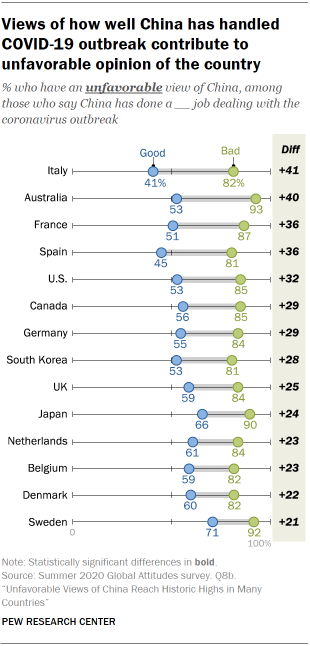
Perceptions of how well China has done handling the coronavirus pandemic color people’s overall views of the country. Those who think China has done a bad job dealing with COVID-19 are much more likely to have an unfavorable view of the country – and the difference is at least 20 percentage points in every country surveyed. For example, in Italy, those who say China has done a bad job handling the coronavirus pandemic are twice as likely to report an unfavorable view of China – 82% vs. 41%, respectively.
In Europe, more see China as world’s top economic power than U.S.
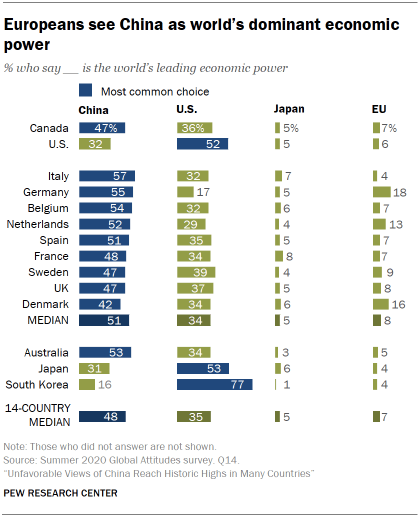
Many major economies are predicted to contract in 2020 amid the pandemic, including those of the U.S., Japan and the euro area. In contrast, the Chinese economy is expected to achieve positive, if modest, growth. Across the 14 countries surveyed, when asked to evaluate the relative economic standing of these areas, a median of 48% identify China as the world’s leading economic power. The U.S. comes second, with a median of 35% seeing it as the world’s top economic power.2 Few see Japan or EU countries similarly.
In most European countries surveyed, about half or more consider China the world’s top economy, compared with about a third who say the same about the U.S. Evaluations of China’s economic standing have a double-digit edge on evaluations of the U.S. economy in seven of the nine European countries. For example, Belgians are 22 percentage points more likely to say China is the top economy than to name the U.S. (54% vs. 32%). At least one-in-ten in Germany, Denmark and the Netherlands also name the countries of the EU as the world’s leading economic power – the highest among all countries surveyed.
South Korea and Japan are the only two countries – aside from the U.S. itself – where more see the U.S. as the world’s leading economy than China. South Koreans are particularly likely to name the U.S., with 77% naming the U.S. as the dominant global economy.
Over the past few years, evaluations of these countries’ international economic standing have generally held steady in the countries surveyed. Such evaluations also do not differ across different age groups and education or income levels, but men are more likely than women to say the U.S. is the world’s leading economic power in half of the countries surveyed.
Little confidence in President Xi to do the right thing in world affairs
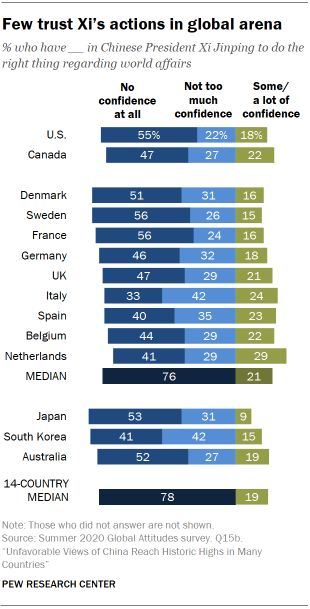
Across the 14 countries surveyed, a median of 78% say they have no confidence in Chinese President Xi to do the right thing when it comes to international affairs, with at least seven-in-ten in every country saying they lack confidence in Xi. Only a median of 19% express any trust.
In the U.S., a majority say they have no confidence at all in Xi (55%), and about half in Canada say the same (47%). No more than a quarter report having any confidence in him in either country.
Europeans report similarly low levels of trust in Xi. A third or more in each country surveyed say they have no confidence at all in the Chinese president, including at least half in Sweden, France and Denmark.
About half in Japan and Australia also say they have no confidence at all in Xi. Japan also stands out as a country where less than 0.5% of the public – effectively no one – reports having a lot of confidence in China’s president, though no more than 5% report having a lot of confidence in him in any country surveyed.
The survey also asked about confidence in five other world leaders. Only confidence in U.S. President Trump is lower than confidence in Xi. When considering median confidence, Russian President Vladimir Putin receives slightly higher marks, while confidence in European leaders Merkel, Macron and Johnson are at least twice as high as in Xi.
Distrust in President Xi has reached unprecedented highs in all countries for which past data is available except for Japan and Spain. The increase in distrust has been especially sharp in the last year; nine of 12 countries have seen a double-digit increase in the share who say they have no confidence in Xi. In Australia, for example, 54% had little or no confidence in Xi in 2019, and now 79% say the same, a 25 percentage point increase.
Confidence in Xi is low among men and women, those with higher and lower levels of education, across age groups and among those with higher and lower incomes.
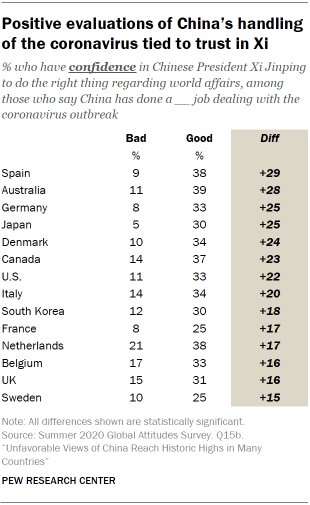
It is also closely related to people’s assessments of how China is handling the coronavirus outbreak. People who think China has done a good job handling COVID-19 are more likely to have confidence in the Chinese president. For instance, 38% of Spaniards who compliment China’s outbreak response trust Xi compared with 9% of those who do not – a 29 percentage point difference. Still, no more than about four-in-ten of those who rate China’s coronavirus outbreak response positively say they trust Xi.
Prediction 203. The following pan-national political movements and alliances will, to some extent, usurp the national sovereignty of various nations: (A) Globalisation, (B) the Connection Movement, (C) Alliances, (D) Hyper-Democracy and (E) the Extremist Left Wing.
Prediction 204. Globalisation will be essential for the formation of a modern-day Antichrist who will have dominion over the majority of the world’s population. It will usurp democratic national sovereignty everywhere.
https://spectator.com.au/2022/05/bend-the-knee-peasants/
The breakdown of the nation-state has been instrumental in global institutions growing their power and influence.
How did this breakdown occur?
There have been a combination of factors: weakened nationalism, Woke ideology, decades of leftist institutionalised indoctrination, corporate social responsibility, the prominence of virtue signalling, and reliance on government. Such things primed society for manipulation and control.
The belief in a healthy level of national pride has dwindled away into nothingness. Its remnants have been replaced with a collectivist ideology so profound and effective it has beaten us into submission. It did so by being quietly institutionalised and ingrained into our subconscious.
In the post-Covid world, if a citizen does not demonstrate that they comply with the current common cause, they are automatically assumed to be against it or sympathise with those who refuse to bend the knee.
With the love of country lost, the era of the global elites has begun.
As the World Economic Forum holds their latest seminar in Davos, elites everywhere have reaffirmed their justification for a crackdown on free speech. They have also toyed with ideas of global surveillance on a level not even conceived by Orwell. Meanwhile, the World Health Organisation has convened to lay the foundation for a global treaty that undermines the sovereignty of nations.
Democratic leaders have felt a rush of self-importance so tantalising that the actual people they are there to represent have gotten foggier with every sip of the expensive champagne. Their blurry vision has left democracies around the world unrecognisable.
The global Covid response, spearheaded by the WHO, demonstrated that citizens of the world were largely compliant. With a bit of fear and coaching, they followed the advice of health bureaucrats who imposed often irrational, draconian, invasive, and destructive policies. People went along with the demands largely due to the threat of fines, avoidance of social stigma, and a genuine fear of the virus resulting from relentless, alarmist legacy media coverage.
Those who remained sceptical turned to information from sources such as The British Medical Journal, investigative journalists like Sharri Markson’s What Really Happened in Wuhan, and academics along the lines of Gigi Foster et al’s The Great Covid Panic.
Independent news outlets began to gain traction as the Real Rushkan brought the realities of Melbourne protests to our screens and Joe Rogan interviewed ‘controversial’ figures such as Dr Robert Malone (contributor inventor of mRNA vaccines).
Despite attempts to censor and discount counter-arguments, big tech and government authorities have not yet been able to eradicate their voices. Framing such counter ideas as ‘misinformation’ and a ‘threat to national security and safety’ is how free speech will be suppressed in the near future.
It is behaviour reminiscent of communist societies.
In the space of less than two years, Australian society has voluntarily commenced the shift from libertarianism to totalitarianism. This was done in the name of a pandemic with a survival rate of 99.5 per cent.
Now we brace for the next phase of the WEF’s global agenda, unashamedly detailed in Klaus Schwab’s book The Great Reset.
As demonstrated in the recent Australian Federal Election, Climate Change is the most important issue for many people and was the deciding factor in the 2022 election. It is the threat of Climate Change that the WEF will use to further their reach into our country.
Modelling and projections of the impact of temperature rise on our planet has so far been inaccurate and exaggerated. Since 1980, scientists have been predicting alarmist outcomes: snow becoming extinct, Antarctica left as the only inhabitable place on Earth, oceans drowning cities, and an array of other apocalyptic predictions that have not come to fruition.
If the climate modelling can’t be trusted and no scientist ever seems prepared to admit to their failings, why do people continue to have faith in the dire predictions? Why did so many people accept the inaccurate modelling of academics such as Imperial College of London’s epidemiologist Neil Ferguson, who stated that Covid was projected to kill at least 40 million people worldwide?
It comes down to fear and how effectively that fear can immerse into the collective psyche.
The exaggerated, disproportionate response to the Covid outbreak has demonstrated how dangerous a blind belief in projected modelling can be. What’s more, the mainstream media betrayed its once sacred duty of holding governments to account. No longer can it be trusted to question, critique, or meaningfully challenge those who are meant to serve the people.
At the WEF forum in Davos, Australia’s eSafety Commissioner Julie Inman has told participants that freedom of speech and other human rights are in need of ‘recalibration’. Inman has denounced the ‘polarisation’ and ‘binary’ feel that is currently playing out online and wants to fix this by curtailing free speech. In other words, it’s far better if we all agree and only receive approved information.
Red flag much?
We all want a healthy, thriving planet but we also want a free, democratic society. Can the two coexist?
Can we achieve better outcomes for the planet and its inhabitants without succumbing to totalitarianism, a growing wealth divide, and destroying the democratic pillars of civilisation?
Can the Enlightenment be born once again?
We need leaders who are willing to defend national sovereignty, resist the influence of global organisations such as the WEF and WHO, and implement policies that honour the lessons from the past and that achieve better outcomes for the planet without sacrificing what liberty we have left.
Australia has not voted for such leaders.
We will therefore be subjected to alarmist policy endorsed by the Teal Independents who represent wealthy constituents. They are busy virtue signalling their climate credentials, comforted in the knowledge that it is not them who will feel the strain of the green policies, but rather the lower income families who lack the privileged position of influence and power.
Prediction 341. Due to the current fear of extreme Right Wing dictatorships mentioned above, if a Right Wing extremist ever plotted a territorial expansion today, or even attempted to mount a preparation for this, he would be quickly quashed, because humanity is currently vigilant in its opposition to Right Wing extremism. However, if an extremist Leftist were to do the same, humanity would be much slower to react, if it reacted at all, mainly because of apathy. This would give such an extremist Leftist both ample time and opportunity to establish power. Thus, after an extremist Left Wing Antichrist, all vigilance will be directed to the Left, so that an extremist Right Wing Antichrist will be able to blindside humanity. Then after an extremist Right Wing Antichrist, all vigilance will be directed to the Right, so that an extremist Left Wing Antichrist will be able to blindside humanity, and so on vice versa. Imagine a person who is about to cross a road. However, they are only looking to the right, never to the left. Their neck is locked to the right. As they cross, they will not be run over by a car that is coming from the left, but they may well be hit by one that is approaching from the right.
Therefore, the stage is set today for an evil extremist Leftist to be supported by the current zeitgeist of extremist Right Wing vigilance, but extremist Left Wing apathy. This apathy results in a naively compliant international population which would allow an extremist Left Wing Antichrist to begin his diabolical work without being detected. However, it is impossible for a Right Wing one to do the same in the current political climate. Like a swinging pendulum, Antichrists move from extreme Left Wing to extreme Right Wing to extreme Left Wing to extreme Right Wing. By doing this, people will be fooled by them, and will not see them coming. Thus, Antichrists must oscillate from Left to Right Wing.
22/6/2022 - Victoria bans the swastika:
https://www.google.com/url?sa=t&rct=j&q=&esrc=s&source=web&cd=&cad=rja&uact=8&ved=2ahUKEwik34X71tn5AhUw9zgGHfQjB4AQFnoECAUQAQ&url=https%3A%2F%2Fwww.bbc.com%2Fnews%2Fworld-australia-61890577&usg=AOvVaw19yRbC44GXADldv_9fP-mz
1/6/2022 - Biden calls the right Wing America's greatest threat.
https://www.google.com/url?sa=t&rct=j&q=&esrc=s&source=web&cd=&cad=rja&uact=8&ved=2ahUKEwj54byS2dn5AhU13jgGHUcNCjwQFnoECAcQAQ&url=https%3A%2F%2Fwww.theguardian.com%2Fus-news%2Flive%2F2021%2Fjun%2F01%2Fjoe-biden-tulsa-oklahoma-race-massacre-us-politics-live&usg=AOvVaw16xhD4adDwKoZ-KlqXWIQV
Victoria has become Australia's first state to specifically ban the display of the Nazi swastika.
Swastika: Victoria bans display of Nazi symbol in Australian first
- Published
22 June
Under a new law, people who intentionally exhibit the symbol face up to a year in jail or a A$22,000 (£12,300; $15,000) fine.
Victorian Premier Dan Andrews said "nobody has the right to spread racism, hate or anti-Semitism".
Like many places globally, Australia has seen a sharp rise in anti-Semitic incidents in recent times.
Victoria already has anti-hate speech laws - but they have been criticised for having "gaps".
A push for reform intensified in 2020 when a couple raised a swastika flag above their home, angering the local community.
State officials called the new legislation a "proud moment". Three other states have said they will introduce similar laws.
"The Nazi symbol glorifies one of the most hateful ideologies in history - its public display does nothing but cause further pain and division," said Victorian Attorney-General Jaclyn Symes in a statement.
There are exemptions for showing the symbol in historical, educational and artistic contexts. It can also be used in Hindu, Buddhist and Jain religious contexts - as it has been for millennia.
People will be prosecuted only if they defy a first request to remove the symbol.
Anti-Defamation Commission chairman Dvir Abramovich - who campaigned for the law - called it a "thunderous blow" to the neo-Nazi movement.
"As our nation confronts the deep stain of a resurgent white-supremacist movement that peddles a dangerous and dehumanising agenda, this parliament has declared that the symbol of Nazism will never find a safe harbour in our state," he told the Australian Broadcasting Corporation.
The number of anti-Semitic incidents around the world dramatically increased last year, according to a study by Tel Aviv University. Australia had 88 in one month alone - a national record.
In 2020, Australia's intelligence chief warned of a "real threat" to the country's security from neo-Nazis. He said "small cells" of right-wing extremists were meeting regularly to salute Nazi flags and share their ideology.
Since the pandemic began, unions and others have also accused far-right groups of "infiltrating" large protests about lockdowns and other restrictions.
The new laws will come into effect in six months.
1/6/2022 - Biden calls the Right Wing America's greatest threat:
Biden officials testify that white supremacists are greatest domestic security threat
by Harper Neidig and Rebecca Beitsch - 05/12/21 2:26 PM ET
The Biden administration’s top law enforcement officials on Wednesday pledged to dedicate their resources to combat domestic violent extremists amid questions over whether the agencies are equipped to monitor such threats in the wake of the Jan. 6 Capitol riot.
Attorney General Merrick Garland and Homeland Security Secretary Alejandro Mayorkas appeared before the Senate Appropriations Committee for a hearing on domestic extremism as Congress ramped up its scrutiny this week of the circumstances around the attack on the Capitol.
Both Garland and Mayorkas testified that white supremacist groups pose the most serious domestic national security threat in the U.S., reinforcing what analysts have long concluded about far-right organizations.
“Domestic violent extremists pose an elevated threat in 2021 and in the FBI’s view, the top domestic violent extremist threat we face comes from racially or ethnically motivated violent extremists, specifically those who advocate for the superiority of the white race,” Garland told lawmakers at the top of the hearing.
But the hearing on Wednesday highlighted the competing partisan priorities as Republicans urged a crackdown on illegal immigration and Democrats questioned whether the agencies are fully prioritizing efforts to prevent the type of domestic extremism that led to the storming of the Capitol.
Garland dismissed concern from Sen. Richard Shelby (R-Ala.) who asked whether the Justice Department was investigating with “equal vigor” protests in Portland, Ore., and other cities that were often a focus of former President Trump.
“We don’t care what the ideology is, violations of law are pursued and are prosecuted. I think it’s fair to say that in my career as a judge, and in law enforcement, I have not seen a more dangerous threat to democracy than the invasion of the Capitol,” Garland said. “There was an attempt to interfere with the fundamental passing of an element of our democracy, the peaceful transfer of power. And if there has to be a hierarchy of things that we prioritize, this would be the one we’d prioritize. It is the most dangerous threat to our democracy. That does not mean that we don’t focus on other threats.”
The Department of Justice has brought more than 400 prosecutions against individuals who participated in the Capitol riot, including members of right-wing groups such as the Oath Keepers and Proud Boys, who are facing conspiracy charges over their alleged roles in planning out operations at the Capitol on Jan. 6.
Some of those charges have also been brought against those with a military or law enforcement background.
Mayorkas faced questions on a recent Department of Homeland Security (DHS) commitment to conduct an internal review of its own workforce to root out any extremist views within its ranks.
“That sends chills down my spine that we have to even be doing that,” committee chairman Patrick Leahy (D-Vt.) said before securing a commitment from Mayorkas to make the conclusions of the review public.
Mayorkas’s appearance before the committee follows an announcement by DHS that they are establishing a specific domestic terror branch within the department’s Office of Intelligence and Analysis and amid reports that DHS plans to increase its scrutiny of social media to root out potential extremist plots.
Sen. Jack Reed (D-R.I.) warned the agencies need to track social media not just to root out plots but to monitor disinformation campaigns from Russia.
“They are using the Jan. 6 assault on the Capitol in such a manner to amplify narratives in furtherance of their policy which is to disrupt and disunite and to indeed destroy, if they could, our democracy,” he said.
But Mayorkas didn’t offer specifics on DHS’s efforts, instead offering up a closed door briefing.
“We are intensely focused on the information with respect to Russia’s effort to sow discord and disunity in our country. And of course we’re bringing an all of government effort to respond to that, and I would welcome the opportunity to brief you in a more appropriate forum to address information we have in that regard,” he said.
While in past hearings on domestic extremism, Republicans have largely sought to encourage the agencies to focus their attention on left-wing extremism, Wednesday’s questions from the GOP were almost exclusively centered on the southern border.
Mayorkas sought to dispel any concerns that swelling migration at the southern border could present a terror threat.
“We don’t have any evidence to suggest that the threat on the border with respect to a foreign terrorist is any greater today than it was last year, the year prior, or the years over the past decade,” he said.
Prediction 162. However, despite the apparent power of movements in the name of anti-racism, anti-poverty, anti-Muslim discrimination, and anti-colonialism, all of these will be absorbed into the Marxist Leftist Movement, which will in turn be absorbed into the China movement, which will in turn be subsumed into AC3. I call this ‘the Subsumption Principle’. And all of this will be co-ordinated by Satan. Even the Great Reset, which is pre-empted in the January 2020 document of the World Economic Forum, and which announces eight predictions for the world for 2030, will be subsumed by China. The WEF has identified China as their chief partner in resetting capitalism. It’s not hard to see that, when these two entities work in partnership, China will eventually get the upper hand.
July and September 2021 - The Taliban gradually coming under effective Chinese control through the Belt and Road Initiative:
https://www.google.com/url?sa=t&rct=j&q=&esrc=s&source=web&cd=&cad=rja&uact=8&ved=2ahUKEwi-sb-j19n5AhUM4TgGHd6_D3EQFnoECBAQAQ&url=https%3A%2F%2Fthediplomat.com%2F2021%2F09%2Fchina-afghanistan-and-the-belt-and-road-initiative-diplomacy-and-reality%2F&usg=AOvVaw2DGBI_eIZZD6J25gF4_yC4
https://www.theguardian.com/world/2021/sep/03/china-to-keep-kabul-embassy-open-and-beef-up-relations-say-taliban
China, Afghanistan, and the Belt and Road Initiative: Diplomacy and Reality
China will face a number of difficulties in implementing the BRI in Afghanistan.
By Magnus Marsden
September 15, 2021
A series of diplomatic statements by China has indicated a “cautious alliance” between the country and the Taliban. On their part, the Taliban have declared China to be Afghanistan’s “main partner.” In the wake of the violent return to power of the Taliban, international leaders have made much of China’s potential role in Afghanistan. Most statements emphasize the possible dividends of growing levels of Chinese investment in Afghanistan in the framework of the Belt and Road Initiative (BRI) – China’s central foreign policy scheme that seeks to create land and sea infrastructural links designed to facilitate economic activity within and beyond Asia.
Serious questions remain, however, about Afghanistan’s incorporation within the Belt and Road project. Most obviously, the security situation in Afghanistan will hamper China’s ability to invest in it. The Taliban have publicly stated they will not interfere in China’s affairs, yet there remains an important question mark over the ability and willingness of their new and internally divided administration to reign in Islamist movements hostile to neighboring states — including China. At the same time, opposition to Taliban rule — both in the form of street protests and in the military activities of the National Resistance Front led by Ahmad Masood — will be a source of further caution in China. Various groups have targeted Chinese personnel in Pakistan in recent months; comparable incidents in Afghanistan would bring the country’s cautious alliance with the Taliban under yet more scrutiny in China itself.
It is also important to go beyond the sphere of bilateral relations and formal diplomacy to understand the difficulties that China will face in implementing the BRI in Afghanistan. An understanding of Afghanistan’s relationships with its neighbors, especially those with expansive geopolitical ambitions, requires recognition also of the role played by informal forms of diplomacy. Afghan populations who reside beyond the country’s territorial borders play an especially key role in informally contributing to Afghanistan’s relationships with its neighbors.
Afghan communities in the wider region are a complex and layered mixture of exiles, traders, and labor migrants. Millions of Afghans have lived in Iran and Pakistan, for example, over the course of several generations. In these countries, Afghan communities have established sustainable businesses, and long-standing social, political, and cultural relationships, even if many do not have access to citizenship or even stable residency rights. Afghans living in the former Soviet states, including the Muslim majority republics of Central Asia, as well as Russia and Ukraine, constitute sizeable communities, too. Afghans across these settings are especially active in trade, yet they have also established vibrant cultural and political associations through which they organize events as well as interact with local and national authorities. These social institutions play an important role in informing the nature of debate in Eurasia about Afghanistan, enabling the countries of the region to keep pace with the changing dynamics of Afghanistan beyond. Similar processes are available elsewhere, most notably in the Gulf States (especially the UAE and Saudi Arabia) and in Turkey.
Diplomat Brief
Weekly Newsletter
N
Get briefed on the story of the week, and developing stories to watch across the Asia-Pacific.Get the Newsletter
Countries in Afghanistan’s neighborhood exert a range of forms of power on the spectrum between “soft” and “hard” in Afghanistan by way of their interactions with Afghan communities. China’s position is different in important respects from that of other countries in Afghanistan’s neighborhood. Historically, China has not accepted refugees from Afghanistan. Afghans living in the country are either students or individuals active in the trade in Chinese commodities, both in Afghanistan and also with other countries in which Afghans reside and are engaged in the commodity trade. The vast majority of the few thousand Afghans living in China reside in the country by way of short-term visas; authorities in China usually issue such visas for one year and, exceptionally, a maximum of five years. Affordable schooling is hard to access for foreigners in China: The majority of Afghans living in the country reside, then, in communities predominantly made of men. The families of Afghan traders based in China mostly live in Afghanistan or in other countries in the region (especially Turkey) where visas and residency permits are (for wealthier businesspeople) relatively easier to come by. Chinese government officials are highly sensitive to migrant communities that seek to establish cultural and political associations in the country. Even to hold community-oriented events, migrants must contend with various levels of bureaucracy.
Enjoying this article? Click here to subscribe for full access. Just $5 a month.
Afghan communities across Asia emphasize the inherently perilous circumstances of their lives and their working activities. A combination of uncertainty about their future legal status in China, and the difficulties they face in establishing meaningful social institutions in the country, means that the scope for Afghans in China to play informal diplomatic roles is considerably narrower than is the case elsewhere in the region. Elsewhere in the region the BRI has empowered large transnational companies and marginalized smaller-scale trading communities. The fragility of the Taliban-led Afghan state, and the ongoing significance of informal institutions to the country’s economy, mean that successful Chinese investment in the country will depend to a significant degree on the mediating role played by Afghan traders and businesspeople.
Beyond the diplomatic portrayal of the smooth flow of Chinese investment in Afghanistan via the BRI lies a far more rocky and uncertain reality. Political instability, the ongoing presence of militant Islamist organizations pursuing transnational objectives, and the comparative weakness of pre-existing social ties and bonds of trust between the two countries are just some of the issues that policymakers will face in the days, months, and years to come. Authors
https://www.theguardian.com/world/2021/sep/03/china-to-keep-kabul-embassy-open-and-beef-up-relations-say-taliban
240. He will enter a zeitgeist where the vast majority of the world’s population will ‘refuse to love the truth and so be saved’ (2 Thessalonians 2:10). And, although ‘that day will not come until the rebellion occurs’ (2 Thessalonians 2: 3), a widespread rebellion against the values of God has already begun. People will be full of pride because the world will be seen to have been made more economically and socially equal and scientifically advanced than it is today, and humans will have taken full credit for this. These people will be, as Timothy described the people of the last days in 2 Timothy 3:1-9, ‘…lovers of themselves, lovers of money, boastful, proud…loaded down with sins and swayed by all kinds of evil desires…’. This description has rung increasingly true down the ages since Christ. Christians will be publicly vilified and abused, and will receive neither protection nor justice. When 2 Thessalonians 2:7 says ‘…but the one who now holds it (the secret power of lawlessness) back will continue to do so until he is taken out of the way’, it refers to a future characterised by a more open opposition to Christianity in traditionally Christian countries than ever before.
Open opposition - 4/11/2013
https://www.abc.net.au/qanda/from-the-festival-of-dangerous-ideas/10657962
DAN SAVAGE: You sit there pathologising other people's choices. You sit there saying that other people being free to live their lives by their own light in some way oppresses you, when it oppresses you in no way whatsoever. You are free not to get gay married. You are free not to use drugs. You are free not to drink. You are free to stay married to one person for the rest of your life. You are free to stay home and raise your wife's children so they always have a parent by their side. You are not free to sit there and say that other people being just as free as you are to live their lives and make their own choices in some way is damaging you personally, in some way is destroying society. People are freer now, happier now. It's a less intolerant world than it used to be because people like me are now empowered to look at people like you and say you are full of shit.
PETER HITCHENS: This is so personal. Can I respond to it before the...
(AUDIENCE APPLAUDE AND CHEER146. In addition, they will strive for and largely achieve the following reforms: national debts to be cancelled; international trade terms to be altered to favour poor countries; formerly colonised countries to return to using their native language, changing their place names and acquiring real power to control their own destinies; the cultures and histories of individual nations to largely replace organised religion as a bonding and guiding force; company CEO wages to reduce to become much closer to that of their workers, who will have increased ownership and control of companies; jobs to adapt to people and not the other way around; accessible housing that will see homes adapt to people and their needs; medicine for all; world music, television and cinema that will see Africans and Asians starring in Western living rooms and around the world; history and philosophy being rewritten according to the viewpoints of indigenous peoples and not the dominant cultures; and environmental responsibility to be forced upon the worst offenders who are USA, China and India.
African stars in western living rooms - 30/8/2022.
https://www.dazeddigital.com/life-culture/article/56846/1/nigeria-has-officially-banned-white-models-in-adverts
Nigeria has officially banned white models in adverts
The ban on foreign actors and voiceover artists is part of a push to foster home-grown talent
For many years, adverts that air in Nigeria have starred white actors, and have been narrated by people with British accents. As of October, however, that looks set to change, as the country enforces a blanket ban on white and other non-Nigerian models, and foreign voiceover artists.
According to Nigeria’s advertising regulator, the ban will cover all non-Nigerian actors, representing a sea change in national feelings toward representing the country’s native population (which numbers more than 200 million).
“Ten to 20 years ago if you checked the commercials, I would say they were almost 50/50 in terms of foreign faces and all the voiceovers were British accents,” Steve Babaeko, president of the Association of Advertising Agencies of Nigeria, tells the Times. Nigerian brands would often use foreign faces, while international corporations would simply import their global campaigns.
However, Babaeko says that a “kind of renaissance” has occurred in Nigeria over the last eight years or so. A “new sense of pride emerging” among its young population, he adds, has led to “backlash” against projects that were obviously shot abroad with foreign models.
“People will tell you, ‘There are about 200 million of us. Are you telling me you could not find indigenous models for this commercial?’”
Taking effect on October 1, the outright ban expands upon an existing tariff, which requires advertisers to pay 100,000 Naira, or around £200, for every foreign model in an advert. The hope is that it will also channel more creative projects into the country and help boost opportunities for home-grown talent. Already, the British agency AMV BBDO has shot an African campaign for Guinness, “Black Shines Brightest”, in Lagos with a Nigerian director and local models, reflecting the shift in the nation’s advertising industry.
Comments
Post a Comment